Landmark notes before the exercise
Middle C is C4. On a treble staff, E4 is the bottom line and G4 is the second line. In bass clef, G2 is the bottom line, B2 the second, D3 the third, F3 the fourth and A3 the top. Half notes last two quarter-note beats in 4/4; a quarter note lasts one.
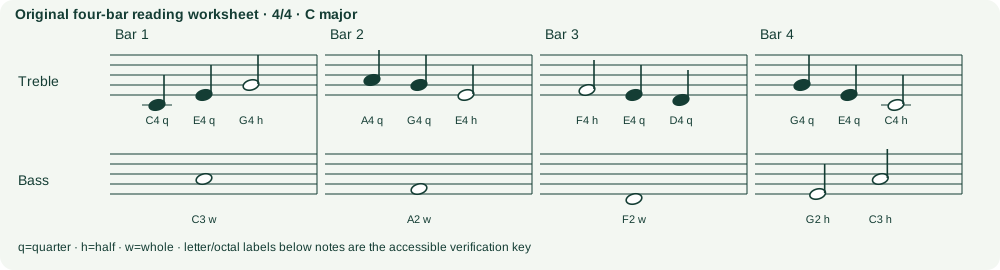
Original four-bar reading worksheet in C major
| Bar | Right hand (treble clef) | Left hand (bass clef) | Beat check |
|---|---|---|---|
| 1 | C4 quarter; E4 quarter; G4 half | C3 whole | 1 + 1 + 2 = 4 |
| 2 | A4 quarter; G4 quarter; E4 half | A2 whole | 1 + 1 + 2 = 4 |
| 3 | F4 half; E4 quarter; D4 quarter | F2 whole | 2 + 1 + 1 = 4 |
| 4 | G4 quarter; E4 quarter; C4 half | G2 half; C3 half | 1 + 1 + 2 = 4 |
The worksheet is original educational notation expressed in text, not a reproduction of a commercial melody. The left hand plays one or two long bass notes while the right hand reads a short phrase. The final left-hand C3 begins on beat 3 beneath the G-chord bar as a simple turnaround toward C; it is intentionally not a constant G bass.
Reading procedure
Point at the treble note names without playing; tap the correct rhythm; find C4 and the remaining notes on the keyboard; play right hand alone; then add the bass. Keep a slow audible count and stop after bar 4. Record a pass to check whether you hold the half notes for their full two beats.
Self-verification key
Bar 1 right hand C–E–G outlines C major. Bar 2 uses A–G–E over A bass; bar 3 F–E–D over F; bar 4 G–E–C moves toward C while the bass changes G→C. Every written measure totals four beats. If you want precise pitch position on a five-line staff, compare these letter names to the appropriate clef landmarks in a published notation reference or with a teacher.
For the basic contrast, see chords versus notation and keyboard notes. Reading can complement rather than replace a chord-first practice routine.
Sources and scope
Source and topic references checked 28 October 2026. The linked articles/course outlines substantiate the indicated general principles and coverage, not our precise original exercise, performance effectiveness, or a first-hand review. Music studies here were independently composed for this site; external musician review before publishing is still outstanding.
- Berklee Online — Music for Beginners syllabus — foundation in rhythm, melody, pitch, keyboard and basic chords; not a validation of this page’s original practice schedule.
- Berklee Online — Music Theory 101 syllabus — notation, triads, inversions, rhythm, lead sheets or key relationships named in the syllabus; not a performance assessment of our examples.