A readable chord map
| Chord | Lowest-to-highest notes in root position | Characteristic note | Example right-hand fingering |
|---|---|---|---|
| C | C–E–G | E makes it major | 1–3–5 |
| F | F–A–C | A makes it major | 1–3–5 |
| G | G–B–D | B makes it major | 1–3–5 |
| Am | A–C–E | C makes it minor | 1–3–5 |
Finger numbers for the right hand: thumb 1, index 2, middle 3, ring 4, little finger 5. Suggested 1–3–5 is a starting option, not a rigid mandate; 1–2–5 can feel easier for some reaches. Use a light motion and avoid locking the wrist. The labels in this table provide an accessible alternative to a visual keyboard diagram.
The colored keys show ascending root-position voicings, not merely note names scattered across C–B. Each diagram begins at its own chord root. For example, F4–A4–C5 and G4–B4–D5 cross the octave boundary above middle C (C4).
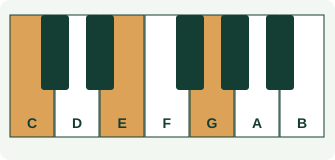
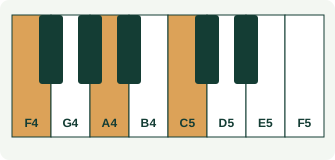
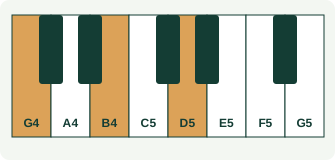
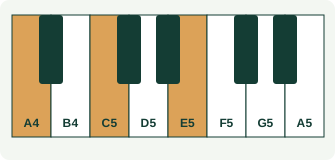
Make the shapes speak in time
Play C, count 1 2 3 4, then F for four counts, G for four, Am for four. Only attack the chord on beat 1 at first. On the repeat, add a gentle second attack on beat 3. Use the bass root with your left hand only after the right-hand rhythm is steady.
Find the deliberate mistake
Try C–E–A, then C–E–G. The first collection is not a C major triad because its fifth is A rather than G. Listen for the changed color, then visually verify the notes. This separates wrong-note errors from rhythm errors; simply speeding up will not correct it.
Four quick shape-change questions
Try each without looking at the answer. Move G up to A: C–E–A is an A minor inversion (A–C–E). F major: F–A–C. C major: C–E–G. Both are white-key triads, but the notes are not interchangeable. G major: G–B–D; Am: A–C–E. All three chord tones change in root position. It is not root-position C major; it is a valid inversion of A minor. The written target determines whether it is an error.1. C major becomes A minor while keeping C and E. Which note moves?
2. F major becomes C major. Name the two collections.
3. G major contains which note that Am does not?
4. Is C–E–A a wrong chord or a different voicing?
Four-step self-check
- Say each chord's letter names without looking.
- Place the fingers before pressing; no sharp wrist bending.
- Change C→Am→F→G at a slow, uninterrupted count.
- Close your eyes after release and find each root again.
Ready to combine them into music? Try the three original four-bar studies. To understand the interval formulas see building triads; for difficult transitions see smooth chord changes and keyboard note locations.
Sources and scope
Published theory and the original exercises above are editorial work, not a first-hand product test. Merchant statements were checked 28 October 2026. Music examples are original text arrangements; independent musician review remains a required prepublication check.