Two-octave location chart
| Octave | C | D | E | F | G | A | B |
|---|---|---|---|---|---|---|---|
| Around middle C | C4 | D4 | E4 | F4 | G4 | A4 | B4 |
| The next octave | C5 | D5 | E5 | F5 | G5 | A5 | B5 |
Between C and D lies C♯/D♭; between D and E lies D♯/E♭. There is no black key between E and F or between B and C. Between F/G, G/A, A/B lie F♯/G♭, G♯/A♭ and A♯/B♭ respectively. Enharmonic spellings refer to the same physical piano key in ordinary equal temperament but different letter functions in notation.
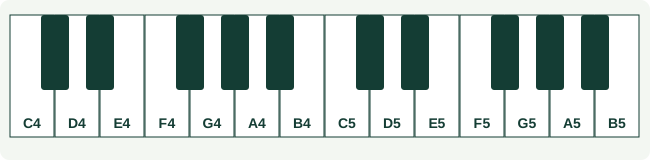
Original eight-step find-the-note test
- Find middle C (C4) using the two-black-key landmark.
- Find C5 directly an octave higher.
- Find D4, one white key right of C4.
- Find F4, the white key left of a three-black-key group.
- Find A4, two white steps right of F4.
- Find B4, one white key before C5.
- Find F♯4, the black key between F4 and G4.
- Find B♭4, the black key between A4 and B4.
Answer check
Steps 1–6 are C4, C5, D4, F4, A4, B4. Step 7 is F♯4/G♭4; step 8 is A♯4/B♭4. Recheck octaves by looking for the next C, not by counting black keys alone.
A five-minute habit
Point to a named note first, then play it; reverse the sequence by playing a note and saying its name. Practise around two different sets of black keys. If you are about to start major/minor chords, finding roots independently will save more time than rushing into more chord shapes.
Sources and scope
Source and topic references checked 28 October 2026. The linked articles/course outlines substantiate the indicated general principles and coverage, not our precise original exercise, performance effectiveness, or a first-hand review. Music studies here were independently composed for this site; external musician review before publishing is still outstanding.
- Berklee Online — Music for Beginners syllabus — foundation in rhythm, melody, pitch, keyboard and basic chords; not a validation of this page’s original practice schedule.
- Berklee Online — Music Theory 101 syllabus — notation, triads, inversions, rhythm, lead sheets or key relationships named in the syllabus; not a performance assessment of our examples.